by Woody Weingarten *
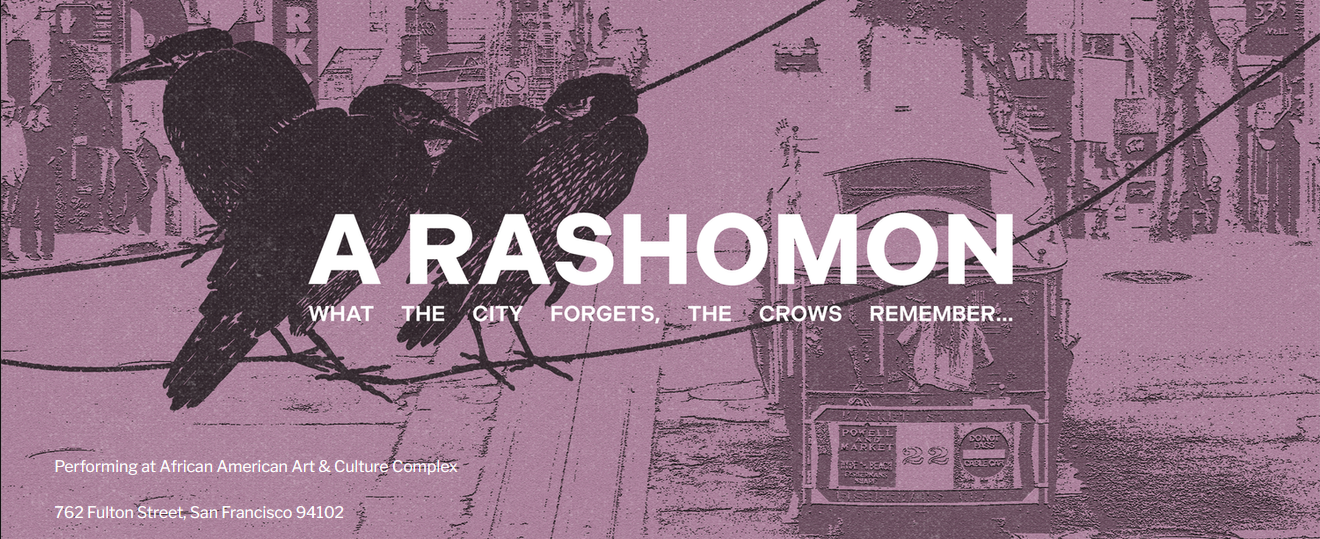
A Rashomon, a Magic Theatre world premiere, deep dives into more than an average theater critic can handle in only an hour.
It grapples with loss of individual Black lives in San Francisco, and loss of big chunks of the Black community population there. It confronts discrimination and angst caused by being invisible, and addresses what it’s like to be a second-class citizen in a white-locked city.
In contrast, it illustrates spirituality and redemption.
The drama was inspired by the 1950 landmark Akira Kurosawa psychological-thriller film that proved multiple storylines could intersect at the same point. In this derivative, denizens of the city attempt to figure out how a Black San Francisco native dies anonymously in his own hometown.
The play, presented in conjunction with Campo Santo, is based on the real-life tale of Robert Henry Johnson’s demise. He was an artist, poet, playwright, and founder of a dance company whose body was held for three months as a John Doe by the city’s coroner — until friends and family worried about him being dead because he’d stopped posting on Facebook.
A Rashomon is multi-layered — with hundreds of quick cuts (and un-quick ones, even in slo-mo) — in a way that might require a theatergoer’s return to pick up at least some of what was missed in the first viewing.
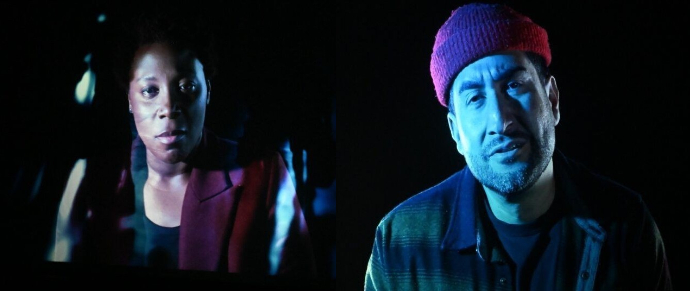
The experimental show on a wide stage at the African American Artist & Cultural Complex spotlights only two living performers, but others are projected as talking heads via video onto two huge screens whose images duplicate everything from different angles, in effect paralleling the multiple views from which the drama coalesces.
Joan Osato, who was in charge of videos and film, was also responsible for the concept of the play, which was superbly directed by Edris Cooper-Anifowoshe and equally well-penned by A.M. Smiley.
Smiley’s fundamental question is: “If a Black man dies on Powell and Market but nobody saw it…how did that happen?”
His reinterpretation of Kurosawa’s Rashomon, he’s said, makes a “fallen native sun of SF the Samurai; the witnesses are layered passersby; and the only reliable witnesses are the crows. It is only right to ask [this question] on the stage Robert Henry Johnson watched his mother perform on, in the building he danced through his entire life, across the street from the building he grew up in.”
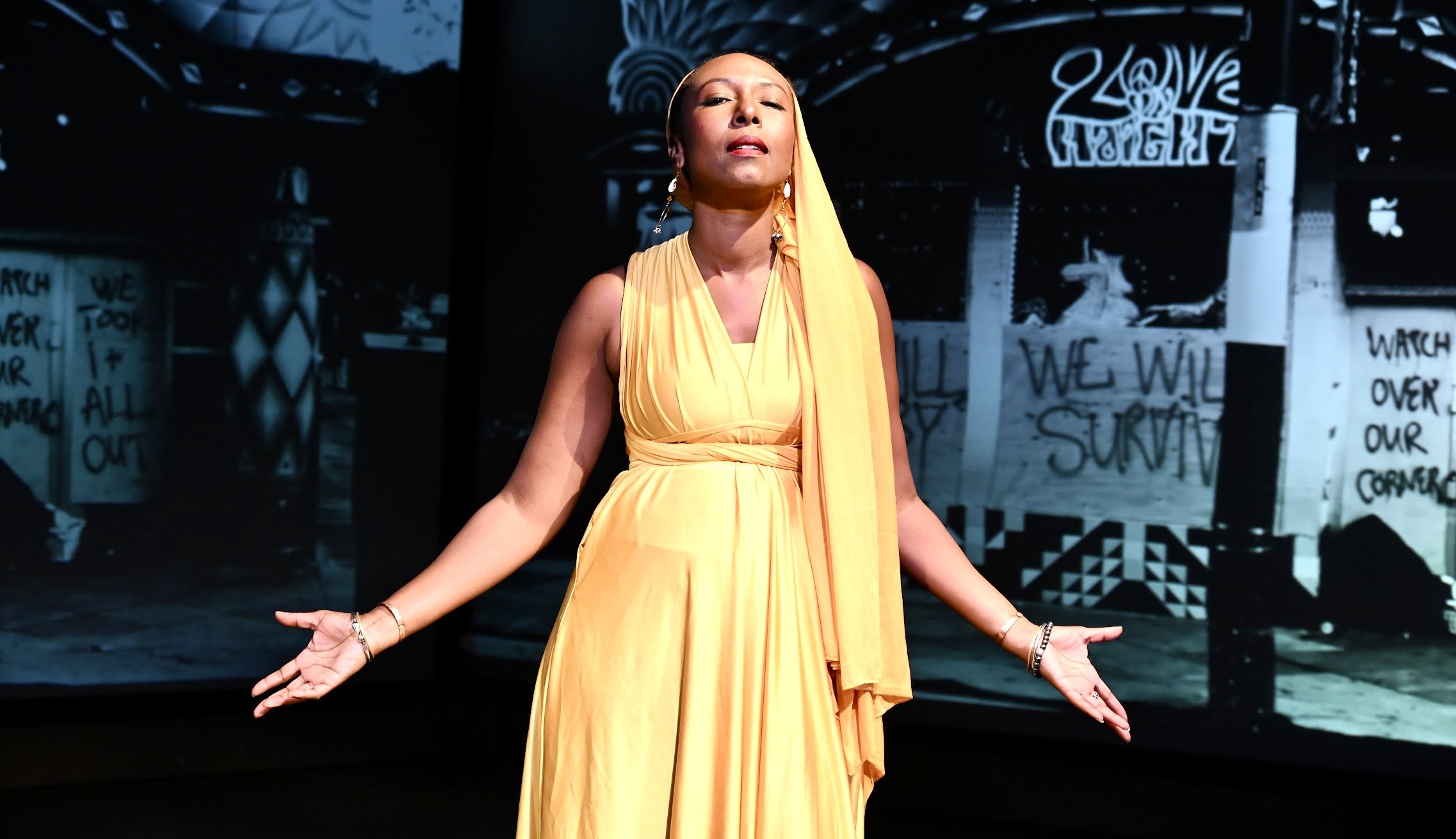
A Rashomon stars Britney Frazier as Divine, clad in a long, flowing dress, who’s alternatively inquisitive, in mourning, celebratory, and furiously angry.
She’s a narrator/participant/spirit who also displays other emotions, but sometimes only intellectually.
Divine — street minister, witness, and spirit guide (who leads No/Somebody’s soul out of his body) — goes through all the stages of grief and offers a eulogy, a service, and moments devoted to the Sermon on the Mount. She tells the story from conflicting points of view a la Rashomon, but also delineates “accuracy” as enumerated, appropriately, by San Francisco’s murder (flock) of black crows.
The multi-faceted character, who makes piercingly direct eye-contact with audience members and who recites both real poetry and some prose she makes sound poetic, now and then offers statements that seem to lack context. Such as the sarcastic but mild “They do say Black folks like living in the past.”
But then, she growls, “Pardon my Negrosity.”
And she offers the revealing question: “How could somebody step over [a] body when there may have been something left?”
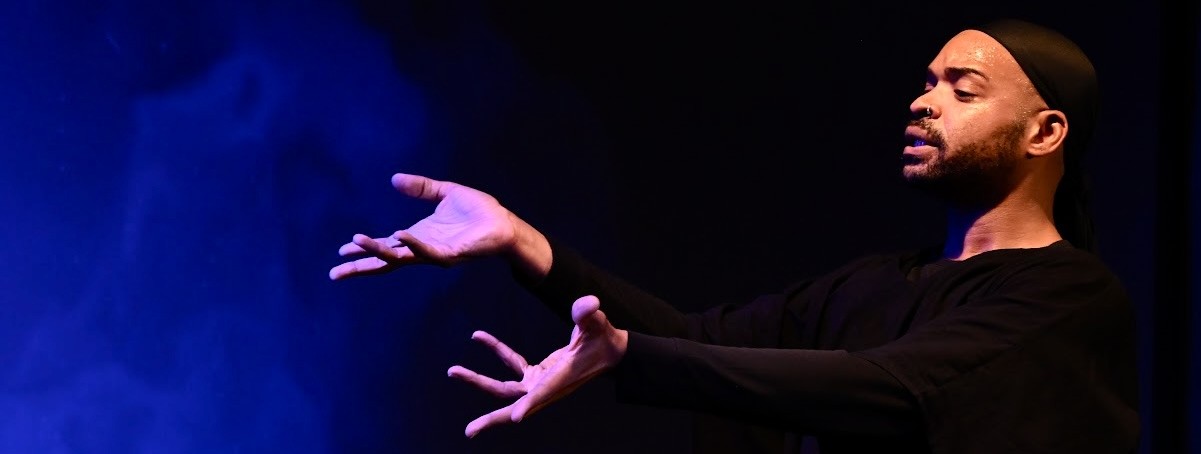
The tension-packed show also features dancer Matthew L. McKines III as No/Somebody, cloaked in black, mostly with a face-covering glitzy mask. His movements, representing the dead body itself, are often graceful. But he ofttimes shifts suddenly to wild and out of control. Always, however, he executes meaningful hand motions that are greatly enhanced, visually, by his long, slim fingers.
Video cameos showcase Jeunée Simon as Mother Mary and mother of No/Somebody who seeks to reunite with her dead son; Juan Amador as Benito, who owns a flower stand on the downtown corner of Powell and Market where No/Somebody mysteriously dies; and Nora el Sasmahy as Amina, an Egyptian transplant who conducts tours that include that corner.
Mary, not incidentally, queries how some people can, when someone dies, “just pass on by” as if the Black man is “transparent.” The sequence is linked to a contrasting, upbeat vaudevillian-like rendition of “Mr. Cellophane.”
Compelling, too, is projected puppetry by Britany White, who also tackled the production design. Her striking shadow puppets take the form of anthropomorphized black crows who tote such props as a lantern or a cane.
Onstage props are limited to an upfront table with multiple candles, two side displays of candles, and a pulpit.
The rear-screen projections are highlighted by myriad clouds — white and puffy and friendly, darkness-laden, swollen with storm water, and vivid because of the perspective that the audience seems to be flying through them.
Clearly, A Rashomon is easier for an audience member to understand if he, she, or they are Black and have been immersed in the community through adulthood.
A few members of an opening week’s Sunday matinee gathering that had been urged at the git-go to participate if they felt like it, in fact applauded, shouted out amens and directives, and occasionally behaved as if they were at a Baptist church service.
Many references to this ‘n’ that frequently contain only one or two words and, therefore, too often remain cryptic, mystic, or muddy because of their not being fleshed out. Somehow, though, lyrics like “How can you mend a broken heart” are right on point.
A publicity blurb for the show, which, sadly, was sparsely attended at that matinee, claims that it “acts as ritual, leaning on the art of augury, a spiritual tradition in which one reads/receives messages through the movements and actions of crows, masquerade, music, and prayer…and lays to rest the Spirits we have lost to physical and spiritual houselessness, substance abuse, grief, cultural deracination and other hazards of living, loving, and creating in San Francisco.”
See it but be sure to bring your imagination and your brain.
Playing through December 6, 2026 at the African American Artist & Cultural Complex, 762 Fulton St., San Francisco.
Click HERE for more information and tickets.
Photos by Jay Yamada
Woody Weingarten is an author, theatre and arts reviewer, and long-time member of the San Francisco Bay Area Theatre Critics Circle. Contact: voodee@sbcglobal.net


