by Woody Weingarten *

Harold Pinter sure packs a brainload into his plays. Take Betrayal, which is on stage at the Marin Theatre through Nov. 15, for example.
• It’s tautly dramatic, with its pinpoint focus on a seven-year affair, predominantly in the ‘70s, between Emma, an art gallery owner played by Liz Sklar, one of the Bay Area’s top performers (who outdoes herself in expressing and not expressing a gamut of emotions), and Jerry, a literary agent portrayed with childish joy and dumbfounded detachment by Tasso Feldman.
• It’s fascinating (and occasionally a tad annoying), a mystery of sorts because it’s a tale told mostly backwards (but also forwards, in spurts) — with minimal dialogue, the playwright’s signature. It starts with a break-up and ends with a playful, lusty seduction at the affair’s beginning.
• It’s chuckle-worthy, a frequent break-the-tension necessity, with Charles Semine inhabiting the third side of the triangle, Robert, Emma’s pompous husband, a book publisher who’s long been unfaithful himself. It’s funniest when Robert engages in — what for Pinter is long — a short circular soliloquy.
• In the final analysis, though, it’s dispiriting and sad, because each main character betrays the other two.
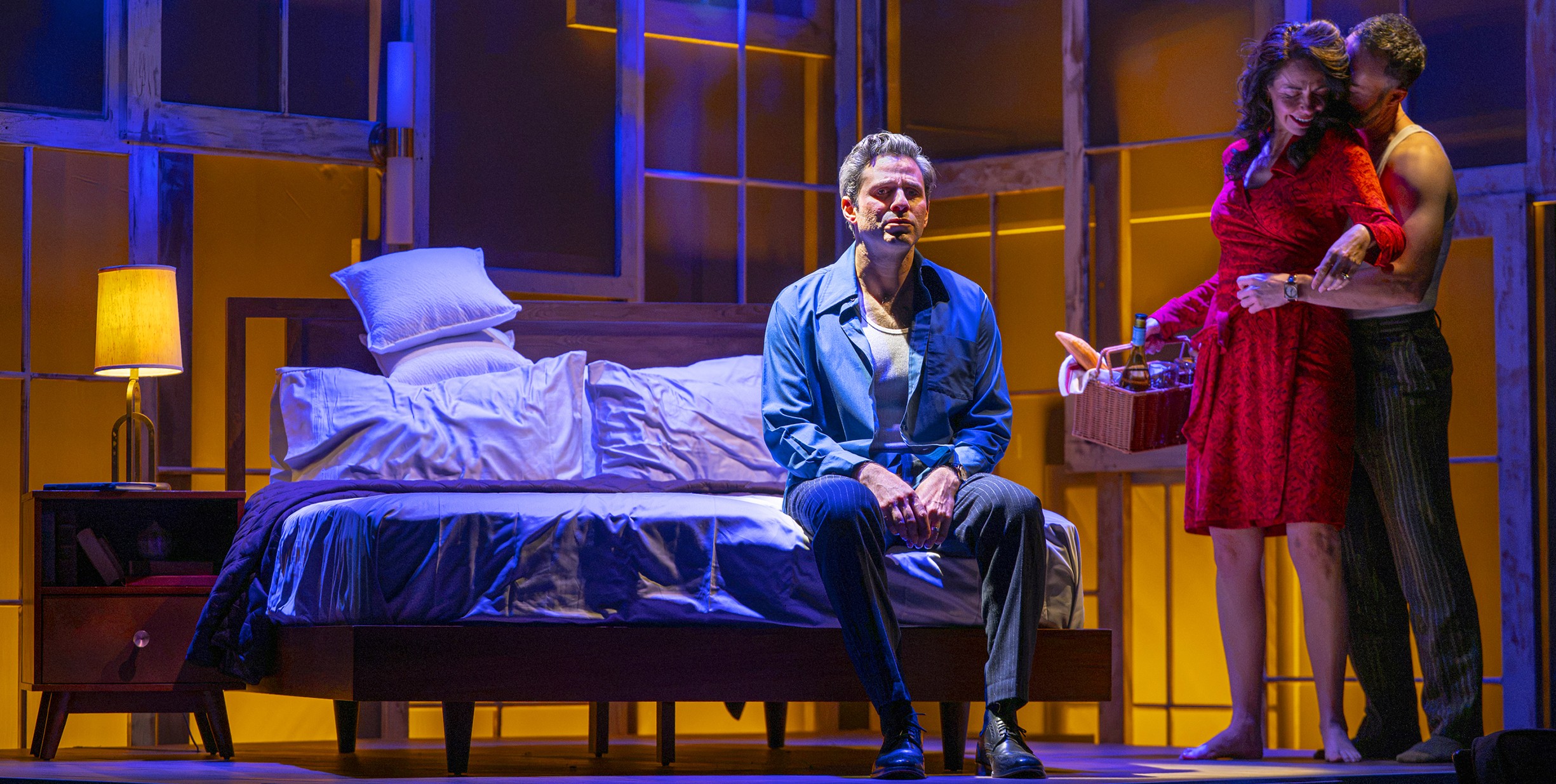
Betrayal, a cerebral, evergreen, prize-winning play that debuted on Broadway in 1980 and has thrice been revived there, painfully explores how human beings have an innate and compulsive ability to be cruel. It surgically cuts, too, into a broad swath of concepts — self-deception, unspoken truths, power struggles, egotism, and a distortion of memories.
Silence embedded in a pause, Pinter’s best-known theatrical device, works exceedingly well in this saga of adultery in the 1970s that ultimately lacks either heroine or hero.
The truth is, an audience member may at times become profoundly uncomfortable knowing an all-too-real secret or lie, knowing moreover that passive viewing won’t work with this close-up portrait of three peeled human onions, that heavy listening and heavy thinking are more than occasionally required — even when the theater can be seen in a rear-view mirror.
That’s true especially if the viewer seeks certainty as to who knew what, when.
Pinter is so skilled he not only puts flesh on his main creations’ bones with amazingly skimpy but meaningful phrases, he employs perfectly a handful of offstage characters that are referenced but never seen — including Jerry’s wife, Judith; a couple of bright, young writers; and everybody’s kids.
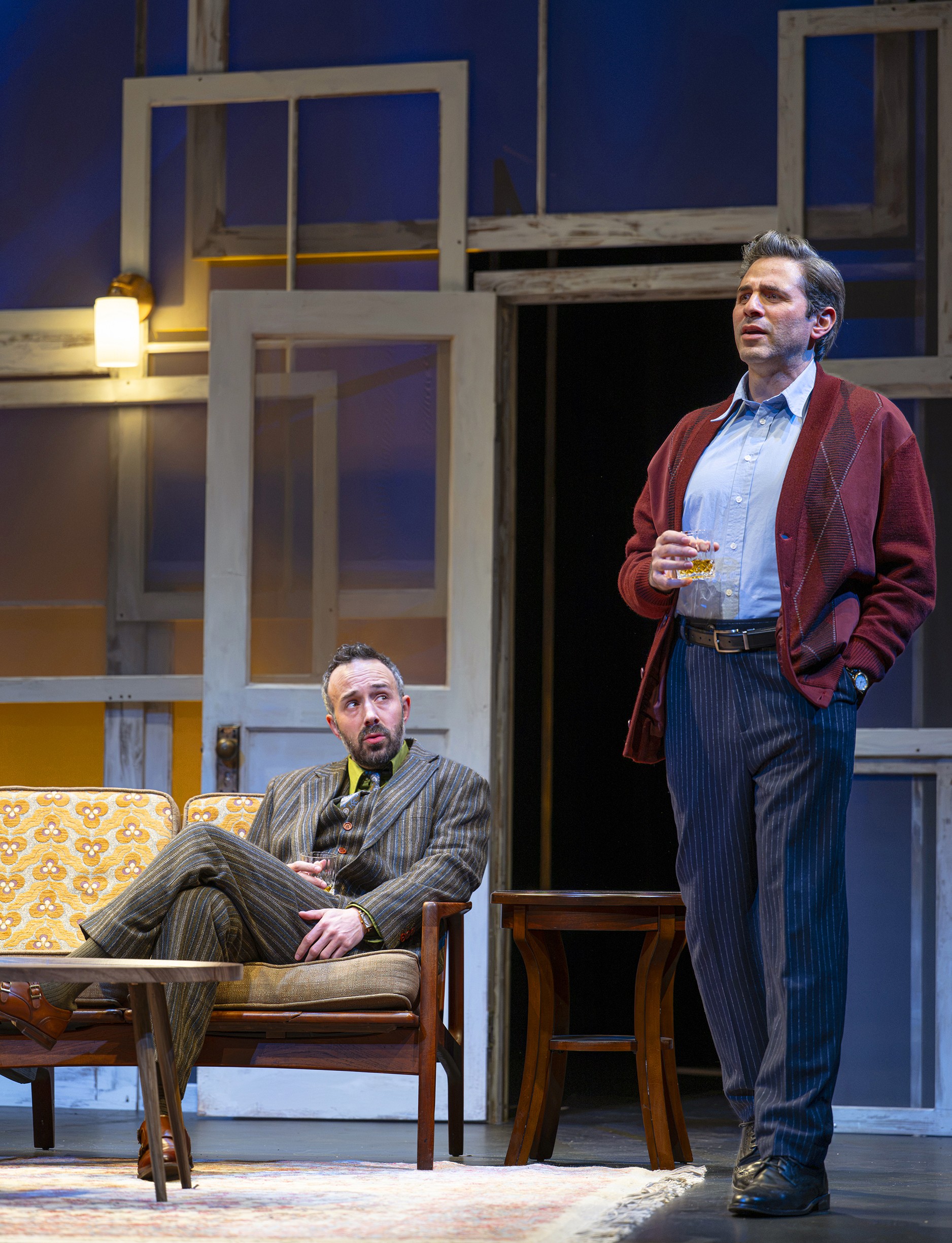
For those who can’t cope with unlikeable characters, the recommendation would be to spend the 1¾-hour run-time doing something else that you would enjoy. If, on the other hand, dissecting relationships is your thing, be sure not to miss this production.
The characters in the play seem painfully real despite Pinter clearly preferring sentences that are limited to five or six words and sentences that would be banal if they weren’t so brilliant. A Nobel Prize-winner, he reportedly based it on his own seven-year affair with a married BBC television personality, Joan Bakewell, while he was wed to actress Vivien Merchant, a relationship that ended up broken.
When Jerry confesses to Robert (“I was your best friend”), the latter replies ironically, “Don’t get upset. What’s the point?”
That question could be asked frequently. A voyeuristic audience member might not get immediate answers, nor immediately grok a nuanced cover-up.
At the same time, some mini-moments overflow with emotion — when Emma and Jerry split, when a letter to Emma becomes a major clue to infidelity, when Jerry simulates a teenager in lust as he seduces Emma, when her pregnancy is disclosed, and when a moving picture of a baby being tossed in the air is projected.
Carey Perloff, who has directed Pinter plays on and off since 1989, when she became his friend and worked on The Birthday Party, proves that she understands precisely what he intends the play to be, how exacting the British accents should be, and how many beats each pause should last. As a result, the ex-American Conservatory Theater director meticulously helps sculpt Betrayal characters into a production that many are likely to consider the very definition of excellence.
Playing through November 15, 2026 at Marin Theatre, 397 Miller Ave., Mill Valley.
Click HERE for more information and tickets.
Photos by David Allen
Woody Weingarten is an author, theatre and arts reviewer, and long-time member of the San Francisco Bay Area Theatre Critics Circle. Contact: voodee@sbcglobal.net


