by Barry Willis *
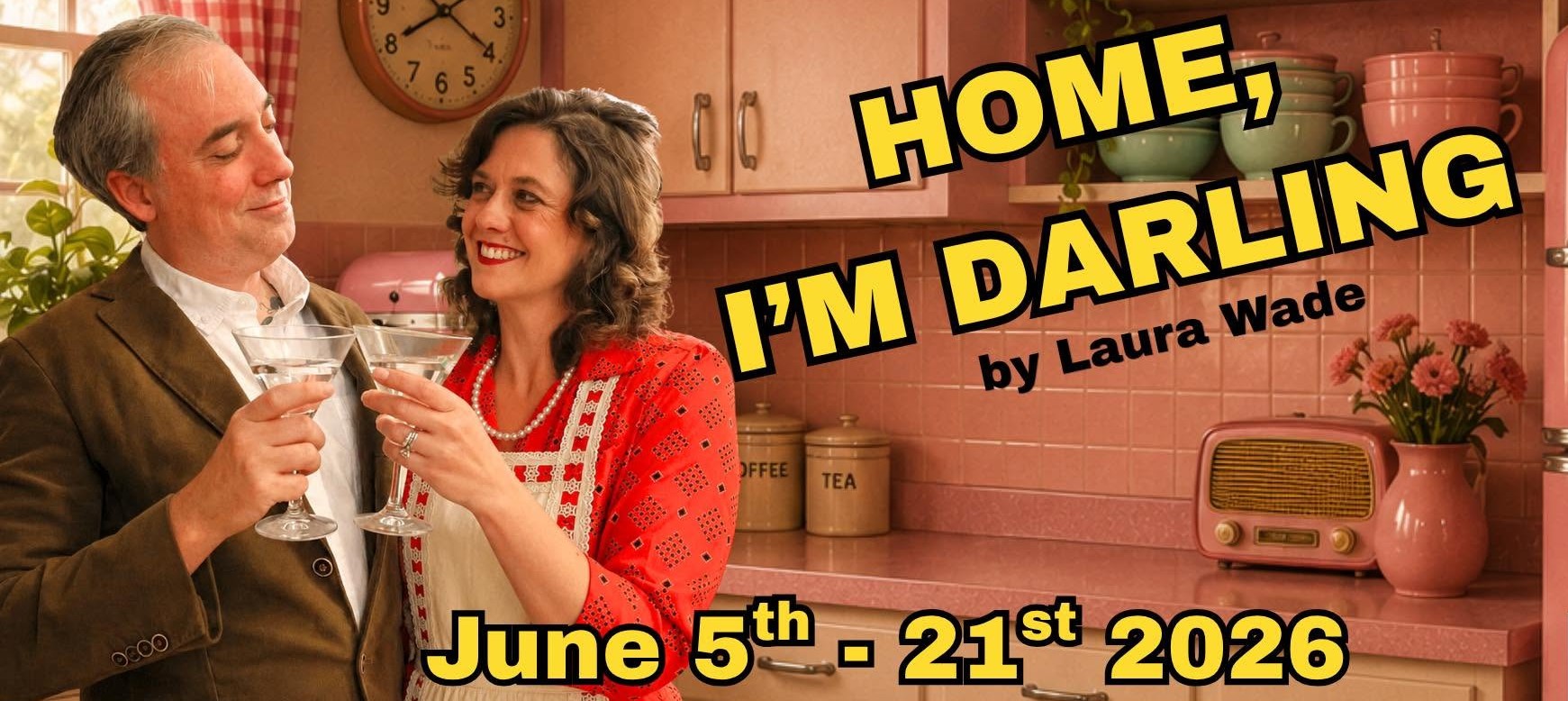
Fantasy and reality collide headlong for a married woman in Laura Wade’s Home, I’m Darling at Sonoma Arts Live through June 21.
Ashley Kennedy stars as Judy, half of a contemporary British couple who have transformed their home into a pastiche of 1950s kitsch—aqua-colored refrigerator and TV, starburst clock, martini glasses, and more. A refugee from the corporate workforce, Judy lives as a self-styled mid-century housewife, complete with flouncy dresses and lacy aprons. The illusion is convincing until we see her pull out a laptop computer and guiltily engage in a bit of web-surfing.
Her husband Johnny (Matt Cadigan) is an estate agent (“realtor” to Americans) who’s angling for a promotion at his company. He goes off to work each day while Judy busies herself with housework—her deep satisfaction with it is a mystery throughout the play—but he leaves the contemporary world behind when he comes home to his “trad wife.”
The playwright did not invent Judy’s delusional syndrome. The “traditional wife” is a real phenomenon of youngish women adopting a make-believe mid-century lifestyle that more-or-less parallels the MAGA movement’s worship of the 1950s as a cultural ideal. It’s misguided at best, as explained by Judy’s mother Sylvia (Sheila Lichirie), and quoted by director Jenny Hollingworth in her playbill notes: “It’s ridiculous. Being nostalgic, when you weren’t even there.”
If “Judy and Johnny” sound familiar, blame Leslie Gore’s lightweight pop song “It’s My Party,” theme music from the era of Judy’s all-encompassing fantasy. She shares the denial mentality of cultists of all kinds, from Civil War re-enactors to Jane Austen fans, who pick and choose favorite bits from the past while ignoring larger realities. Civil War buffs miss the fact that in the 1800s, a relatively minor wound easily treatable today was basically a death sentence from a hideous infection. Austen-ites who spend summers at rural retreats forget that in Austen’s time, personal hygiene was mostly unknown. Women of that era added new layers of petticoats as the inner ones rotted away. Imagine the stench. That’s the past as it was actually lived.
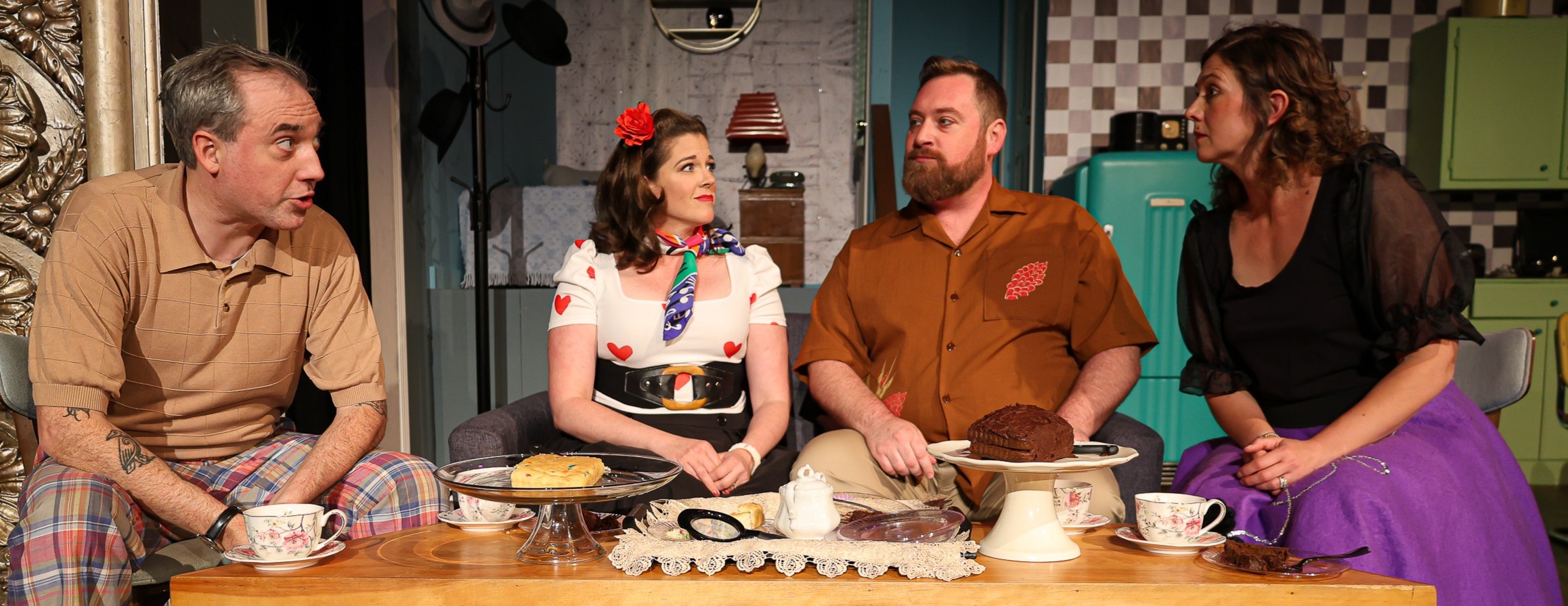
In America’s 1950s and ‘60s, blackout drinking and chain-smoking were the lifestyle of choice for many people—a key theme in the popular TV series Mad Men. The situation was even worse in Britain, where Home, I’m Darling is set, with widespread damage from WWII, and persistent food and fuel shortages. Judy’s mother Sylvia tries to set her straight about what life was really like 70 years ago. It was not a Doris Day romantic comedy.
This dose of reality is a high point in the script, but playwright Wade doesn’t deal honestly with her audience in conveying Judy’s backstory. At one point Judy tells her friend Fran (Julianne Bradbury) that she grew up in a grubby commune where none of the residents worked but spent most of their time analyzing themselves and each other. Her reference to surviving on a diet of “lentil lasagna” will resonate with anyone who lived through that social fad, but insisting that she was a teenager in the mid-1970s (when communal living was at its peak) would make her 65 years old today. Yet Sylvia asserts that her daughter is 38. This disparity is only one of several inconsistencies in Wade’s script.
Or perhaps it isn’t, and Judy’s communal experience is only one of her many delusions, such as a strong secondary plot about her denial of an impending financial crisis, with her savings exhausted and Johnny’s job in jeopardy. Marital infidelity is another strong secondary plot, with Johnny admitting that he’s smitten with his boss Alex (Allison Lovelace), and Fran’s charming husband Marcus (Kevin Bordi) revealing himself as a newly-unemployable sexual predator and creepy manipulator.
Home, I’m Darling may have played well in its native Britain, and could enjoy some popularity here in the States were it rewritten to take place in suburban Connecticut or Southern California. It’s well performed on a kitsch-bedizened set by Carl Jordan and Jaime Love.
Billed as a comedy, it’s not a knee-slapper but a semi-serious depiction of one woman’s self-created trap. Its several comedic scenes lighten the tale, as does a happily-ever-after ending that would perfectly close out any mid-century TV sitcom.
Playing through June 21at the Sonoma Community Centrer, 276 East Napa St, Sonoma.
Info and tickets at https://sonomaartslive.org/
Photos by Katie Kelley Photography
Barry Willis is a member of the American Theatre Critics Association and president of the San Francisco Bay Area Theatre Critics Circle. Contact: barry.m.willis@gmail.com


The worst play I have ever seen and it was almost 2.5 hours long. The banter was awful and the overall themes of the play are feminist stereotypes degrading and shaming traditional husband and wife roles. In reductive terms, women who stay home and run the household are not capable of managing a budget, are boring and have nothing interesting to say, while men who work and provide are chauvinistic pigs who, because they are the providers, are entitled to force s#x on their wives anytime they want. These tropes are tiresome and part of a movement that has led to the destruction of positive traditional husband-wife roles.
LikeLike