by Barry Willis *

Decades of Cuba’s revolution unfold in the microcosm of an elaborate kitchen in a stately old home in Eduardo Machado’s The Cook, at Berkeley Rep’s Peet’s Theatre through October 11.
The perfect focal point for the venue’s steeply-raked three-sided seating, Tanya Orellana’s huge stunning set exquisitely captures the decadence of old Havana.
The story opens late on New Year’s Eve, 1958, also the eve of a sociopolitical upheaval whose repercussions endure to this day. Gladys (Yesenia Iglesias), the home’s superb cook, works feverishly making a feast for party guests, most of them late to arrive. Her worried-but-imperious employer Adria (Gisela Chipe) insists that they turn the clocks back an hour to accommodate latecomers.
“Turning back the clock” is a powerful metaphor for the pair’s refusal to acknowledge inevitable changes swirling around them, conveyed by explosions in the distance, mixed with celebratory music and the shouts of revelers—all of it effectively delivered via sound design and original music by Mikaal Suliaman.
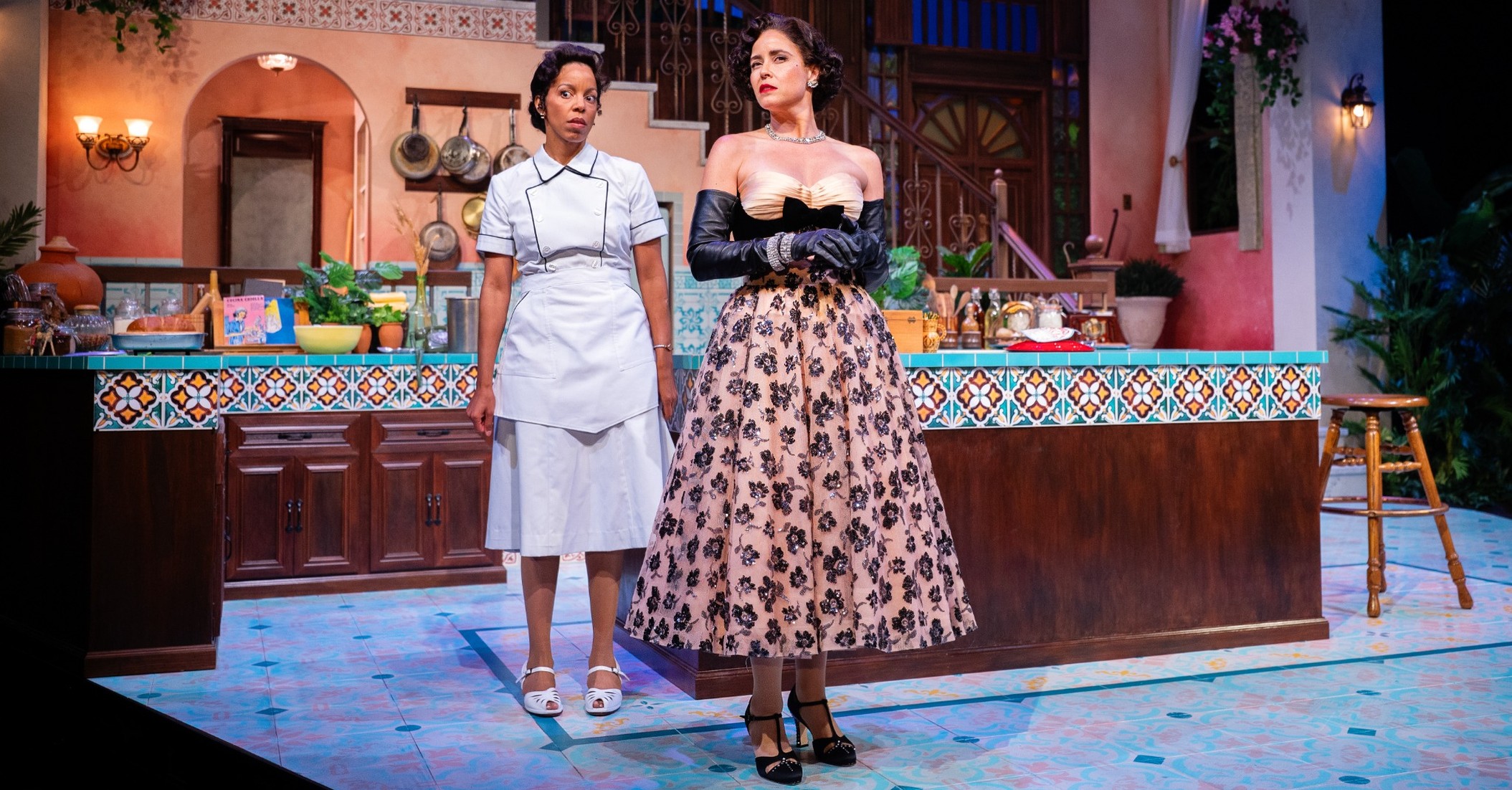
Gladys recruits her disgruntled husband Carlos (Daniel Duque-Estrada), a chauffeur in uniform, to help deliver platters of food to the party. He cooperates unwillingly; her smartly-attired cousin Julio (Ashton Muniz) also serves as a waiter, regaling Gladys with his interest in fashion as he dashes in and out of the kitchen.
Julio’s clearly gay, a fact of only marginal interest to Gladys. What’s not clear is how gays were treated in pre-revolutionary Cuba, when the island was a playground for wealthy tourists. In one of many ironic threads in Machado’s script, we learn that Fidel Castro’s Communist Party had little tolerance for lifestyle diversity. There’s a mention of Raul Castro visiting China and asking for advice about dealing with homosexuals. A Chinese official says “We kill them and throw them in river.” Welcome to a perfect society.
A similar theme is Machado’s treatment of racism—in the Batista era, Cuban society was a pyramid, black on the bottom and white on top. Fifty years later, it’s still uncertain how much of it persists.
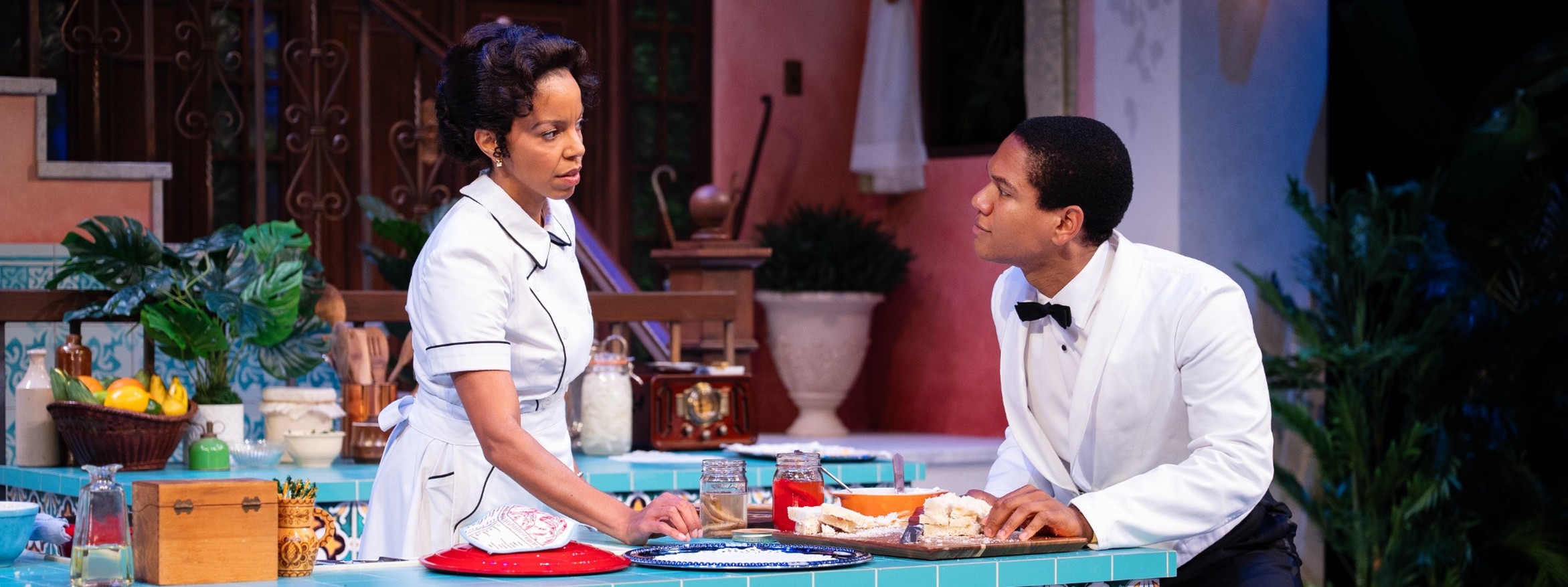
Powerfully directed by David Mendizabal, and powerfully performed by a cast of five Equity actors, The Cook explores themes of love, loyalty (both political and personal) and social justice — all without pandering or preaching, with intermittent comedic elements that leaven its seriousness. The characters make decisions good, bad, and questionable—sometimes to their benefit and sometimes their detriment. Loyal revolutionary Carlos becomes a third-tier party boss, evolving in some ways into an oppressor such as he had previously resented.
Adria departs abruptly, saying that she’s going to Paris while actually heading to Miami, and telling Gladys to take care of the house until she returns—an assignment that the cook accepts with the utmost sincerity. She manages to do so through fifty years of turmoil and economic hardship, an admirable survivor in a long-running socio-economic maelstrom.
Strong, focused and efficient, Gladys remains steadfast through incomprehensibly difficult circumstances. Her endurance through all of it is one woman’s extraordinary story, and the story of an island nation whose evolution is still very much in process.
Playing through October 11, 2026 in Peet’s Theatre at Berkeley Repertory Theatre, 2025 Addison St., Berkeley.
Click HERE for more information and tickets.
Photos by Ben Krantz Studio
Barry Willis is a member of the American Theatre Critics Association and past president of the SF Bay Area Theatre Critics Circle. Contact: barry.m.willis@gmail.com


