
Well, the 46th annual Mill Valley Film Festival is now in the books, having concluded last Sunday night with a multi-screen unveiling of the much-anticipated new film Maestro, and one last big party that turned the streets of San Rafael into a dance club. Per tradition, the most common conversation-starter among the guests was the question, “So what did you think of the film?” That’s been the case from the beginning of the 10-day extravaganza that began on Oct. 5 and involved the screenings of 149 films, most of which had two screenings spread out across the 1.5-week festival.
In a recent review on this site, the possibility of Oscars was discussed, given MVFF’s track record from screening at least a few top nomination getters. The general consensus among the champagne-sipping, gelato-tasting, slider-enjoying patrons at the closing night party is that the two films most certain to see multiple Oscar nominations are The Zone of Interest, which played on Friday, Oct. 6, and Maestro, a film directed by and starring Bradley Cooper, about the soaring artistic rise, twisty relationship struggles and seemingly endeless emotional contradictions of the great composer/conductor Leonard Bernstein.
The Zone of Interest, written and directed by British filmmaker Jonathan Glazer (Sexy Beast, Under the Skin), is loosely (very, very loosely) based on the 2014 novel by the late author Martin Amis. For what it’s worth, the novel deserves another, more faithful go as a film, because the story it tells is riveting and well worth telling. That is not to say that Glazer’s audacious, keen-eyed, laser-focused adaptation is not brilliantly conceived, expertly carried out, and every bit as riveting and worthy of any and all Oscar attention it receives, because it very much (very, very much) does.
Amis’ novel, set during WWII, follows Paul Doll — the commandant of the Polish death camp Auschwitz — who was a fictionilized version of the real-life Auschwitz commandant Rudolf Höss (Christian Friedel) and his wife Hedwig (Sandra Hüller). In a series of chronological sequences, the couple raise a family, entertain friends and family, argue about petty disagreements, laugh about fond remembrances of the past, and carefully build a beautiful backyard garden, all while billowing smokestacks rise above the wall that separates them from the camp Höss oversees. At night, the constant rumbling of furnases and the pop-pop-pop of execution squads form the (mostly ignored) auditory backdrop to their petty, intricately detailed lives. And though the occasional house guest becomes silently overwhelmed by the enormity of the human carnage taking place just a few feet from their bedrooms, the Höss family merely revels in the oppulence and luxury their social position now affords them.
We never see what’s happening on the other side of that wall, but the sounds from the camp are nearly constant, and it’s hard to imagine that viewers will not have vivid enough and graphic enough historical images in their minds without Glazer needing to show them.

Make no mistake. This is a hard watch. But the skillfulness with which Glazer and his excellent cast carry it all out, and the rising emotional gut-twist that comes from watching these people methodically turning their backs to so much human suffering, adds up to one of the most powerful and impressive Holocaust films ever made. To the artists responsible, high marks go to cinematographer Łukasz Żal, and sound designer Johnnie Burn, the latter presented with the Cannes Film Festival’s CST artist-technician prize for his work on the film. And the movie would not be nearly as effective without the alarmingly strange, industrial-noise-layered soundtrack of composer Mica Levi, whose hellish instrumentations won her the soundtrack award at Cannes.
The Zone of Interest, while not very pleasant to watch, is nonetheless a must see cinematic experience.
Maestro, though somewhat more conventional a film, is similarly willing to subvert expectations, at times to a thrilling degree. From a screenplay written by Cooper and Josh Singer (Spotlight, The Post, First Man), the film moves through Leonard Bernstein’s life – specifically his relationship with his wife Felicia Montealegre — in a string of artfully conceived vignettes and “moments” that range from big, bravura travelling shots that span time and place to soft, still scenes so deeply personal and private you might find yourself holding your breath so as not to interrupt it. In fact, some scenes could leave an audience feeling a bit voyeuristic as we find ourselves eavesdropping on such intensely painful moments in Bernstein’s complex family life.

The genius of Cooper and Singer’s script is in how it eschews the traditional biopic approach of hitting all the most important and well known moments of a public figure’s life story, instead choosing moments that reveal sides of Bernstein through slightly less predictable events. We don’t see him at work composing West Side Story, for example — probably his most famous work, which barely gets a mention in the movie — but we do see him at his piano, immersed in writing “Mass,” a soaring and emotional, but generally lesser-known project that was commissioned for the opening of the Kennedy Center. (Personally, I hope the film leads to a rediscovery of “Mass,” a bold and beautiful examination of faith and doubt, with some of Bernstein’s most incredible music).
The performances are first-rate as well. Cooper is extraordinary, and the scene where we finally see him conducting a full orchestral movement — the camera moving all around the hall, through the orchestra, up to the conductor and away again — is drop-dead stunning, so fully does Cooper capture Bernstein’s ecstatic concentration. As Montealegre, Carey Mulligan plays a range of emotions and experiences as full and ferocious as Bernstein playing all the keys on a piano. The supportering cast is equally strong, most notably Sarah Silverman as Bernstein’s sister Shirley, and Maya Hawke as Montealegre and Bernstein’s daughter Jamie.
This is not a film about how Bernstein became famous and went on to acclaimed as one of the most talented and successful conductor-composers in American history, though it does touch on that. Maestro focuses primarily on Bernstein as a force of nature, a man whose spirit and creativity frequently intoxicated and overwhelmed (and often exhausted) everyone around him, including himself. More than anything, it’s about the contradictions and conflicts at the center of all that talent. As a gay man with huge appetites at a time when such an identity had to be covered up, forcing him for a time to lie to the people he loved the most, it’s also an enormous love story, showing that his rocky marriage to Montealegre was more than just a cover.
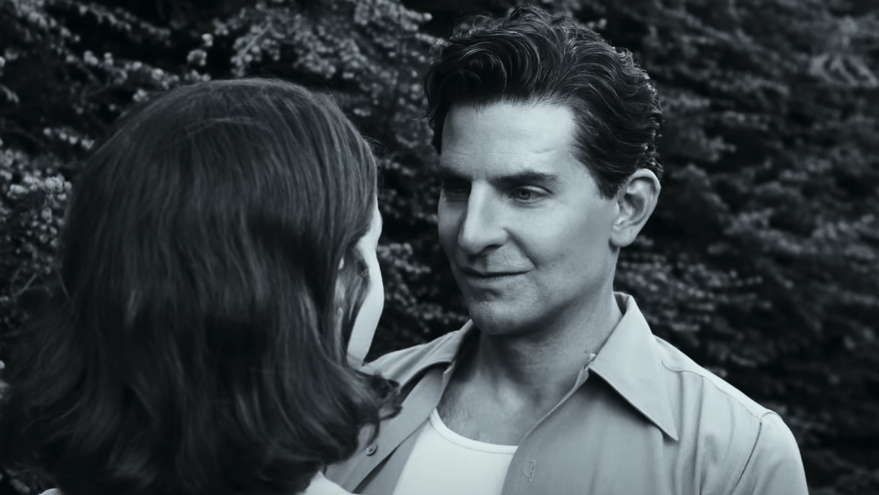
As a director, Cooper shows that A Star of Born was no fluke. His mastery of the camera and his ambition and invention are frequently jaw-dropping, with full credit to cinematographer Matthew Libatique, who often keeps the camera just far enough away from the small moments to make us lean in emotionally, eager to catch every drop, while at other times inviting us to sit back in our seats and try to keep up with all the motion and grandeur on the screen.
Maestro is a true masterpiece, establishing Cooper as a great director, as eager to dazzle as to make us squirm in the messy discomfort of real people’s lives. Nothing less would be appropriate in elling the story of a figure as towering and complicated as Leonard Bernstein.


 North Bay Stage and Screen